In Brightest Day, in Blackest Night
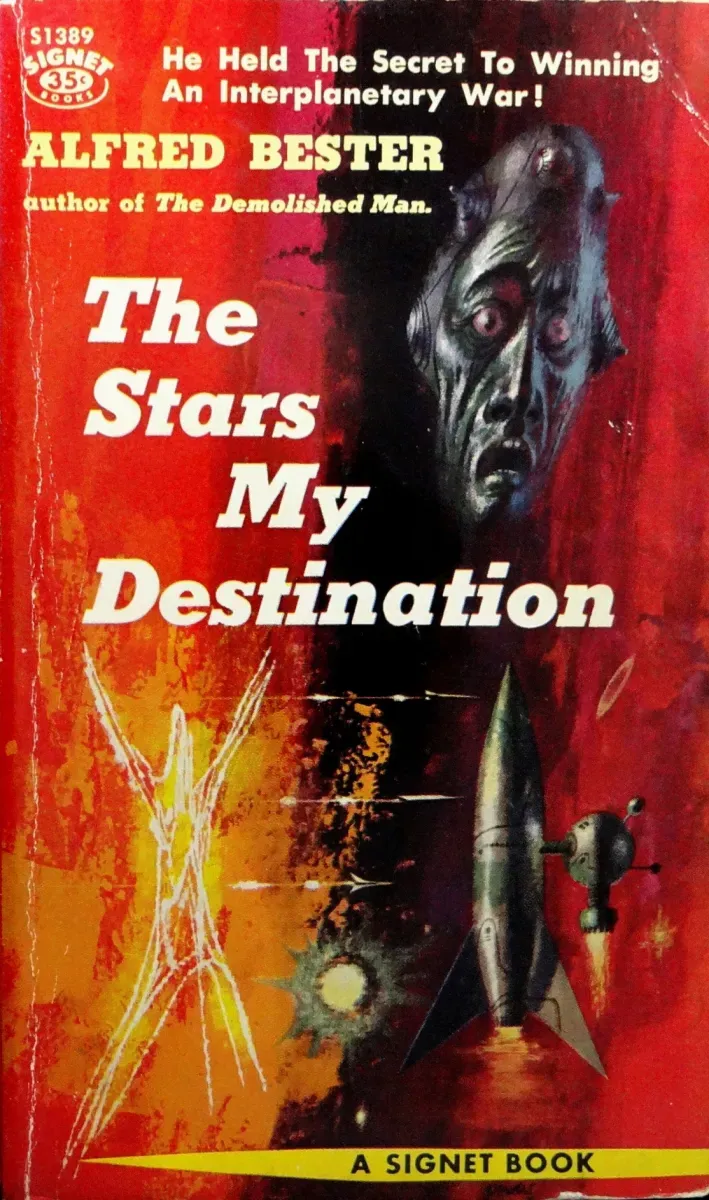
SF Masterworks #5: The Stars My Destination, by Alfred Bester
Spoiler Warning: This review gives away the plot of the book. Completely.
He was one hundred and seventy days dying and not yet dead. He fought for survival with the passion of a beast in a trap. He was delirious and rotting, but occasionally his primitive mind emerged from the burning nightmare of survival into something resembling sanity. Then he lifted his mute face to Eternity and muttered: “What’s a matter, me? Help, you goddamn gods! Help, is all.”
— opening lines of Chapter 1 of The Stars My Destination, by Alfred Bester
In 1943, a young scriptwriter at DC Comics gave the Green Lantern his oath. "In brightest day, in blackest night / No evil shall escape my sight." The lines have survived eight decades, several reboots and at least one terrible film. They scan like a Victorian incantation, and that is no accident. Their author understood that a superhero's mantra must work as ritual. He had learned this from Bill Finger, the star comics writer of the period, who on a rainy Saturday afternoon gave a potential rival what Bester later called "an incisive, illuminating lecture on the craft." Bester regarded that afternoon as a high point in the generosity of one colleague to another.
Thirteen years later, the man who wrote the Green Lantern's catchphrase published one of the most formally ambitious science fiction novels of the 1950s.
The plot
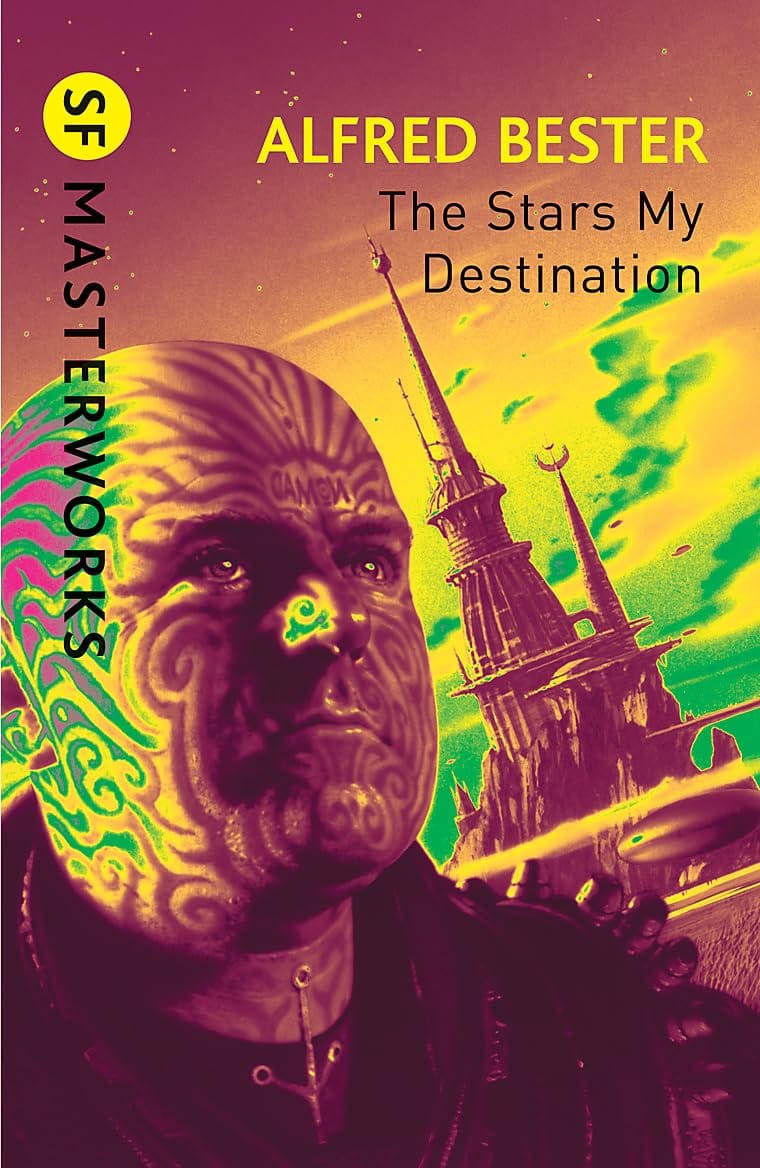
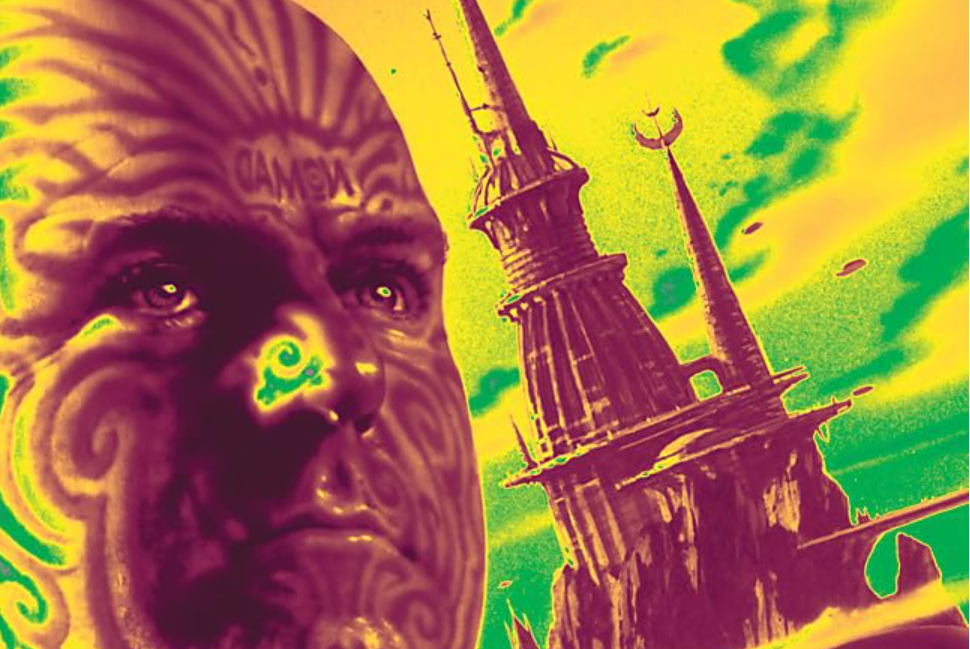
Gully Foyle is a man of no education, no ambition and no potential. He is the sole survivor of the spaceship Nomad, drifting in the wreckage for 170 days, when the passing ship Vorga spots his distress signal and refuses to stop. The indifference is casual, corporate and complete. It transforms him from doomed castaway to apex predator.
He is picked up by the Scientific People, a cargo cult living on an asteroid in the Sargasso, who tattoo a Maori-style tiger mask onto his face and marry him to a woman named Moira. He escapes by blasting off in one of the captured spaceships that make up their habitat, destroying much of it in the process. Captured and imprisoned in the Gouffre Martel, a subterranean labyrinth of permanent darkness where jaunting is useless (there are no visual landmarks to aim for), he meets Jisbella McQueen, a clever criminal who recognises his raw potential and begins his education. They escape together. Foyle uses a hidden fortune from the Nomad to fund a total transformation: illegal surgery to accelerate his nervous system, removal of his tattoos (though they still flush red when he loses his temper), and the creation of a new identity as the flamboyant aristocrat Geoffrey Fourmyle of Ceres.
He hunts the people responsible for the Vorga's order. In the process he discovers that the ship was carrying PyrE, a substance detonated by thought with enough energy to destroy the solar system. The revenge plot reaches its climax when he finds that Olivia Presteign, the blind, infrared-seeing daughter of his corporate nemesis, gave the order to leave him. He falls in love with her. She turns out to be a genuine sociopath.
In the final convergence, Foyle is trapped in the burning ruins of St Patrick's Cathedral after PyrE detonates. The trauma cross-wires his senses: he sees sounds and smells colours. In this state he discovers that he can jaunte not merely across planetary distance but through space and time, appearing to his past self as the "Burning Man" he glimpsed while drifting on the Nomad. It is the novel's delayed explanation for how Foyle survived in the first place: dumped into space, he had jaunted across the vacuum into the wreck without knowing he had done the impossible. In the resolution, he transcends his revenge. He scatters the PyrE among the common people and tells them it is their responsibility to decide whether they are men or animals. Then he returns to the wreckage of the Nomad, now part of the Scientific People's salvage asteroid, and curls up in his old tool locker, burning with revelation. Moira finds him. Joseph, the priest, comes to exact punishment but sees that Foyle has already found it in himself. They settle down alongside him, prepared to await the awakening.
The Count in space
Bester was open about his structural debt to Alexandre Dumas. In his autobiographical essay "My Affair with Science Fiction" (collected in Hell's Cartographers, 1975), he wrote:
For some time I'd been toying with the notion of using the Count of Monte Cristo pattern for a story. The reason is simple; I'd always preferred the anti-hero and I'd always found high drama in compulsive types.
He had already rehearsed the Monte Cristo pattern once before. His 1954 short story "5,271,009" uses many of the same structural elements: the wronged man, the transformation, the revenge. It also contains the nonsense-Germanic strings that reappear in Stars, suggesting that Bester's linguistic experiments with decayed technical jargon were a recurring fascination rather than a one-off flourish. The story also features a series of pneumatically described women to whom the protagonist might be betrothed, which points to something persistent in Bester's self-image: the breezy mid-century male assumption that women are erotic rewards, narrative ornaments, or proof of masculine vitality. Even the title of his autobiographical essay, "My Affair with Science Fiction," carries the implications of a brief but satisfying dalliance (satisfying for him, at any rate). His posthumously published Madison Avenue novel, Tender Loving Rage, reads as a locker-room male fantasy. This assumption will matter later.
The parallels between Dumas and Bester are structural and specific. Both protagonists are betrayed, imprisoned, educated in captivity, enriched, transformed and unleashed upon those who wronged them. But Bester inverts the moral architecture at every joint. Edmond Dantes is an innocent man destroyed by conspiracy. Gully Foyle is a brute destroyed by indifference. Where Dantes is educated by the saintly Abbe Faria, a priest who bequeaths wisdom out of paternal love, Foyle gets Jisbella McQueen, a criminal who recognises his raw power and teaches him to speak like a gentleman not for culture's sake but to hide the animal long enough to get close to his victims. And where Dantes leaves the Chateau d'If with a map to physical treasure, Foyle leaves the Gouffre Martel with the tiger tattooed on his face and the strategic intellect to reclaim the Nomad's cargo, which is not gold but an apocalyptic weapon.
The crucial divergence, as D. Harlan Wilson observes in the Palgrave companion to the novel, is that Dantes becomes the Count to play God: a refined, detached instrument of providence. Foyle becomes Fourmyle of Ceres to play a trick. His mask of aristocratic composure is constantly betrayed by the tiger flushing through his skin. Dantes can successfully bury the sailor; the clod is always millimetres beneath Foyle's surface.
The Monte Cristo framework also gave Bester a ready-made ending. Dumas' Count eventually chooses mercy over total destruction after his mechanical vengeance begins claiming innocent lives. Foyle's version of mercy is more terrifying: he hands the fire to the mob and dares them to evolve or die. But both novels end with the protagonist stepping back from the human race, having discovered that revenge is a smaller thing than he imagined. Dantes sails away with Haydee. Foyle returns to the Nomad, now embedded in the asteroid of the people he wronged at the start of the novel, and curls up to sleep.
Where the framework becomes a trap, however, is in its treatment of women. More on this shortly.
Blake, Dickens, Joyce, and the literary debts
The prologue itself, with its rolling antitheses ("It was a golden age, a time of high adventure, rich living, and hard dying..."), is a recognisable riff on the opening of A Tale of Two Cities. Bester uses Dickens' "best of times, worst of times" structure to establish the duality of a civilisation in which teleportation has made both freedom and invasion universal.
The deeper literary debt is to James Joyce, and Bester acknowledged it. In "My Affair with Science Fiction" he discusses his obsession with Joyce at length. The most visible inheritance is the experimental typography of the synaesthesia sequence, where words scatter across the page in shapes and sizes that simulate sensory overload, the closest a 1956 novel could come to being a graphic novel without illustrations. Delany, in The Jewel-Hinged Jaw, argued that this sequence was also a dramatisation of Rimbaud's theory of the "systematic derangement of the senses to achieve the unknown," and that the Rimbaud reference was as conscious as the references to Joyce and Blake. But the subtler and more interesting parallel, identified by Wilson, is structural. The nursery rhyme that frames the novel, "Gully Foyle is my name / And Terra is my nation. / Deep space is my dwelling place, / The stars my destination," revises a lyric from A Portrait of the Artist as a Young Man: "Stephen Dedalus is my name, / Ireland is my nation. / Clongowes is my dwellingplace / and heaven my expectation." In Joyce, the lyric is a prank scribbled on a schoolboy's flyleaf. In Bester, it becomes a statement of evolutionary purpose. Both express a compulsion to escape the nation that binds the protagonist, and both frame the novel as a story about the forging of identity through pressure.
The comic book on the page
Bester got into comics because several of his pulp editors moved to DC and brought him along. During his time there he wrote for Superman, Batman and Green Lantern before growing bored with the medium's constraints and moving into radio. But the medium left its mark on his prose not as influence but as technique.
The cut scenes near the end of Stars read like storyboard directions. When one of Foyle's collaborators falls to his death, Jisbella's rush to look at the body is described with the visual economy of a panel transition, stripped of connective tissue, all contrast and beat. The hard jumps in the final jaunting sequence are "gutter jumps": the spaces between panels where the reader's imagination supplies the transition. Bester wrote prose that mimicked sequential art's demand that the eye do the work.
The experimental typography is his most overt comic-book move, but the tiger tattoo may be the most revealing. It carries Blake's thematic weight (as discussed above), but it is also a piece of character design in the comics tradition: a visual "tell" that externalises internal state. When Foyle is calm, he passes as civilised. When his rage surfaces, the tattoo flushes through his cosmetic surgery and brands him as the animal he is. Bester had learned, or at least absorbed, one of comics' central lessons: characters in a visual medium need an external, graphic manifestation of their interior life. The tattoo is that lesson applied to prose.
The final chord
All of these techniques converge in the synaesthesia sequence at the novel's climax. The rapid cuts, the gutter jumps, the typographic explosions, the staccato pacing, all of it accumulates into a Stapledon-and-Clarke "I give you the stars" moment of transcendence. It is one of the most accomplished and complete closing movements in science fiction: the kind of cymbal-crash ending James Blish reaches for in Cities in Flight and never quite lands for me. When I first read it, I had to put the book down and walk around for a while. I have only had that experience with one other novel, and that was One Hundred Years of Solitude: not because the books resemble each other, but because both made the world outside the page feel temporarily too small for what had just happened inside it.
Robin Wednesbury and the cost of Foyle's redemption
Robin Wednesbury is, for the period, a remarkable creation. She is black, intelligent, telepathically gifted and central to the plot. Samuel R. Delany, who was not given to casual praise, admired Bester for writing a significant black character in an era when the Golden Age of science fiction was almost exclusively white. The word "Negro" appears four times in the text, which was the formal and respectful term in 1956. (Bester uses the full racial slur elsewhere, in "My Affair with Science Fiction", in a passage that is dismissive from a liberal perspective and tells you everything about the limits of Manhattan liberalism in the Eisenhower years.)
But Bester's treatment of Robin is fatally compromised by the rape.
There is a structural problem here as well as a moral one. Robin is a "telesender": she can broadcast her thoughts telepathically but cannot receive. Bester needs her for the Cristo plot as a kind of Cyrano, wandering through events and telling Foyle how to react. But her talent, which makes her useful, also makes her vulnerable, because anyone near her has access to her unguarded thoughts. Bester, who thought all his ideas through with ruthless mechanical consistency, seems to have followed the logic of Robin's vulnerability to its ugliest conclusion without noticing that the logic was his to refuse.
It happens offstage. Foyle corners Robin, threatens to report her as an alien-belligerent to Intelligence, carries her to a couch, and throws her down. "Nothing," he repeats. The scene fades to black. Later, Robin accuses him of rape. Near the end of the novel, Foyle confesses to it. The text is unambiguous about what happened, even as it declines to show it. Neil Gaiman, in his introduction to the Byron Preiss edition, treats the scene as an example of 1956 reticence: in modern writing, he suggests, the rape would take place onstage. But explicitness is not the problem. One wants to reply that in better modern writing the only black female character would not be raped at all.
Foyle's commission of the act is not the difficulty. Bester's entire project depends on Foyle starting at moral zero: a man of no qualities except the capacity for violence and spite. The difficulty is what happens afterwards. Robin forgives him. She continues to work with him. Bester presents this as evidence of her moral superiority, and it reads today as grotesque.
Part of the difficulty may lie in Bester's source material. Most readers know The Count of Monte Cristo through adaptations or abridged editions that present it as a rollicking adventure of betrayal and revenge. The unabridged novel is far darker. Fernand's history includes the abduction and enslavement of Haydee's mother, and the sexual violence is one of the passages most frequently cut. Dumas' novel is not the innocent source it appears to be. But Dumas never asks the reader to accept rape as a waystation on the hero's road to enlightenment. Bester does. He seems to have followed the Monte Cristo pattern into territory his own liberal instincts could not navigate, then compounded the problem by attaching the crime to a black woman in a novel where racial identity is already handled with the clumsy goodwill of a man who thinks representation is sufficient.
The Palgrave companion to the novel puts this bluntly. Rape is a recurrent theme in Bester's work. It surfaces in "Fondly Fahrenheit," where Vandaleur speculates that his psychotic android may have raped a child. A posthumously published novel, ostensibly a satire of Madison Avenue, was originally titled Tender Loving Rape until his editor Charles Platt persuaded him to change it to Tender Loving Rage. (It is godawful.) Wilson describes Gully as the "most hostile, reprehensible rapist of all." Bester does not condone the act explicitly or implicitly; Foyle's violence is framed as the behaviour of an "Unleashed Id" that must be overcome. But the novel asks Robin to do the overcoming on Foyle's behalf, and it never interrogates the cost to her. Wilson observes that "scholarship on his work has collectively glossed over the issue."
The treatment of women more broadly is a weakness Bester shared with much male-authored science fiction of the 1950s. Jisbella's speech about jaunting locking women back into the seraglio ("After a thousand years of civilisation we're still property") is a rare moment of structural critique, but even this is delivered as exposition in service of the male protagonist's education. Bester's women are beautiful, dedicated to the hero, and, as Charles Platt noted in Dream Makers, "altogether delightfully ineffectual." Robin is also called "Congo Venus" in banter between an assistant and the intelligence officer Y'ang Yeovil, whom she ultimately marries. The label exoticises her in the act of admiring her, and tells you more about the author than the character.
The long shadow
M. John Harrison identified the political core: "Bester was one of the first to see that Popular Mechanics does not free but enslave us." That single sentence positions Bester against the Campbellian tradition of science fiction as engineering manual. Bester's corporations are not problems to be solved by competent men with slide rules; they are feudal powers with private armies and total disregard for planetary law. Harrison's reading makes Stars a founding text of the New Wave.
Delany, in The Jewel-Hinged Jaw, treated the novel as a case study in how science fiction sentences work, examining the way technological discourse literalises metaphor and transforms the impossible into text. Elsewhere he put it more simply: "Bester is easily the SF writer who brought expertise to its full fruition."
William Gibson, writing for the Library of America, remembered rediscovering the novel in his twenties and finding it built on "bones pilfered from Dumas and Dickens (steal only the best)," clad in "archly sophisticated Mad Ave ur-hipness" that made most of its assumed genre "look hick." Bruce Sterling, Gibson reported, called it "a seamless pop artifact." The cyberpunk movement is often presented as the novel's most important legacy, but K.W. Jeter offered a useful corrective: "What's being labeled as cyberpunk is just the usual rediscovery of Alfred Bester that happens every two or three years in the SF field." Almost everything supposedly new, Jeter argued, "really resembles nothing so much as Alfred Bester's closet. Or his wastebasket."
Ty Franck, one half of the James S.A. Corey partnership, has described The Stars My Destination as one of the books that rewired his sense of storytelling. The parallels with The Expanse are specific: the inner/outer political geography, the rebellious daughter of an ultra-wealthy family as catalyst for a system-wide conspiracy involving a transformative substance, and the protagonist's compulsion to hand a dangerous truth to the public regardless of consequences. Alan Moore titled an early, self-drawn strip for the UK music magazine Sounds as "The Stars My Degradation," which tells you how deeply the novel had penetrated. And when ITV produced its 1970s telefantasy answer to Doctor Who, The Tomorrow People, its young mutants teleported by "jaunting." Only steal from the best, as Gibson says.
Bester's prose drew on a visual language comics had developed before the postwar moral panic narrowed the medium's ambitions. When he entered comics, the neighbouring newspaper-strip tradition still had Eisner, Caniff and a mass adult readership; by the time Stars appeared, comic books had been pushed into defensive infantilisation by Wertham, the Senate hearings and the Comics Code. It is an irony Bester would have appreciated that an early prestige graphic-story adaptation, Howard Chaykin and Byron Preiss's version of The Stars My Destination, begun in 1979 and only completed in 1992, returned the novel to the visual medium whose lessons it had already absorbed. Its anti-hero, a man of zero qualities forged into something unprecedented by nothing more than spite, keeps being rediscovered because the archetype keeps being needed.
Delany referred to the book as "considered by many readers and writers, both in and outside the field, to be the greatest single SF novel." The quote appears on some current editions. It is indeed a masterpiece of its time, but it has aged unevenly. Its brightest components, the invention, the brilliant structure, the literary agility, burn very brightly indeed. The darker elements have become more visible over time. Bester built a novel about human transformation and then failed to extend the courtesy of full humanity to its most important female character. In brightest day, in blackest night. The burning man burns. The question is what he leaves in ashes.
Sources
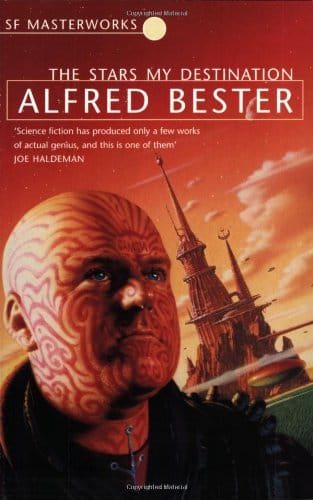
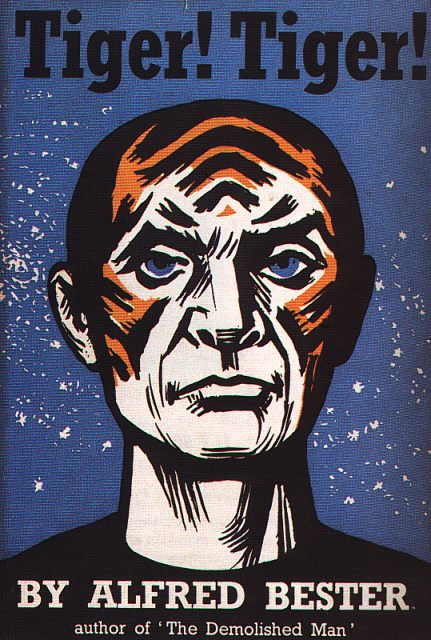
Alfred Bester, The Stars My Destination (Signet, 1957; originally published as Tiger! Tiger!, Sidgwick & Jackson, 1956). The current Gollancz SF Masterworks edition is the most widely available UK text.
Alfred Bester, "My Affair with Science Fiction," in Brian Aldiss and Harry Harrison (eds), Hell's Cartographers (Weidenfeld & Nicolson, 1975).
Alfred Bester, "5,271,009," in Virtual Unrealities: The Short Fiction of Alfred Bester (Vintage, 1997; still in print). Originally published in Fantasy and Science Fiction, March 1954. See also James Wallace Harris, "5,271,009 by Alfred Bester," Auxiliary Memory, 29 June 2018.
Alfred Bester, Tender Loving Rage (Tafford, 1991). Originally written in 1959 as Tender Loving Rape; title changed at the suggestion of Charles Platt.
Alexandre Dumas, The Count of Monte Cristo (1844). The unabridged text is significantly darker than most adaptations suggest.
D. Harlan Wilson (ed.), Alfred Bester's The Stars My Destination (Palgrave Science Fiction and Fantasy: A New Canon, 2019). The principal scholarly companion to the novel; source for the Joyce/Portrait of the Artist parallel, the discussion of rape in Bester's work, and the Platt and Harrison quotations cited in this essay.
Samuel R. Delany, The Jewel-Hinged Jaw: Notes on the Language of Science Fiction (Dragon Press, 1977; revised edition, Wesleyan University Press, 2009). Source for the Rimbaud/"systematic derangement of the senses" reading and the analysis of how science fiction sentences function.
Charles Platt, Dream Makers: The Uncommon People Who Write Science Fiction (Berkley, 1980). Source for the "altogether delightfully ineffectual" observation on Bester's female characters.
William Gibson, "Alfred Bester," Library of America. Source for "bones pilfered from Dumas and Dickens" and Sterling's "seamless pop artifact."
K.W. Jeter, quoted in Michael Bishop, Preface to "In Memoriam: Alfred Bester 1913-1987," in Michael Bishop (ed.), Nebula Awards 23 (Harcourt Brace Jovanovich, 1987), 22-24. Cited in Wilson.
Neil Gaiman, Introduction to the Byron Preiss edition of The Stars My Destination (iBooks, 1996).
Howard Chaykin and Byron Preiss, The Stars My Destination (graphic adaptation; Volume One, Baronet, 1979; complete edition, Epic/Marvel, 1992).
Jad Smith, Alfred Bester (Modern Masters of Science Fiction, University of Illinois Press, 2017). Discusses the Ouspensky and Ali Nomad connections not explored in this essay.
Member discussion