
The Golden Age of Science Fiction is When You're Twelve
SF Masterworks #3: Cities in Flight, by James Blish
Spoiler Warning: This review gives away the plot of the book. Completely.
From the embankment of the long-abandoned Erie-Lackawanna-Pennsylvania Railroad, Chris sat silently watching the city of Scranton, Pennsylvania, preparing to take off, and sucked meditatively upon the red and white clover around him.
— Opening lines of A Life for the Stars, book 2 of Cities in Flight
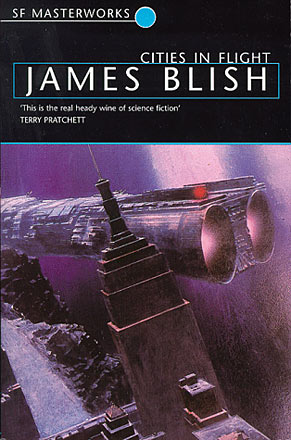
The idea at the centre of the book is that of a powerful anti-gravity drive, the "spindizzy". Given that it doesn't depend on aerodynamics, you can attach it to pretty much anything big enough to hold the engines and turn that thing into an anti-gravity vehicle and, ultimately, a starship. Why not, reasons the author, strap it to a city; and so the cities of Earth become vast interstellar spaceships, scattering across the galaxy. The cities become nomadic; they wander space, looking for work to feed their populations and fuel their engines. In an intensely competitive environment, the value of their labour collapses to near-zero; Blish draws a direct analogy between his migrant cities and the impoverished "Okie" labourers who migrated west during America's Depression in the 1930s.
The spindizzy isn't the only novum in the sequence. Blish is full of ideas – Harlan Ellison, in his 2002 re-introduction to Dangerous Visions, referred to Blish as "likely the smartest one of us all".[1] His cities teem with invention: the "Dirac Transmitter" for instantaneous faster-than-light communication; the "City Father" AIs who run the cities; anagathic drugs that make citizens effectively immortal. What the cities don't have is many people. And those inhabitants you do meet are, by and large, unsympathetic.
The Four Books
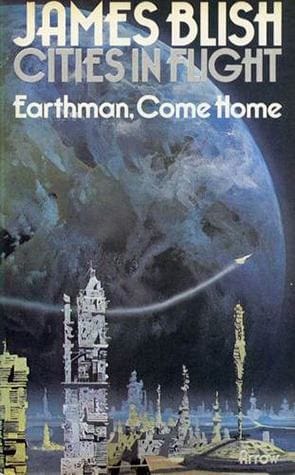
In fact, the four novels were written in the order 3, 1, 4, 2 – that is, Earthman, Come Home first, then They Shall Have Stars, then The Triumph of Time, and finally A Life for the Stars. They were stitched together in 1970. This necessitated, as we'll see, a significant re-edit to make the continuity work.
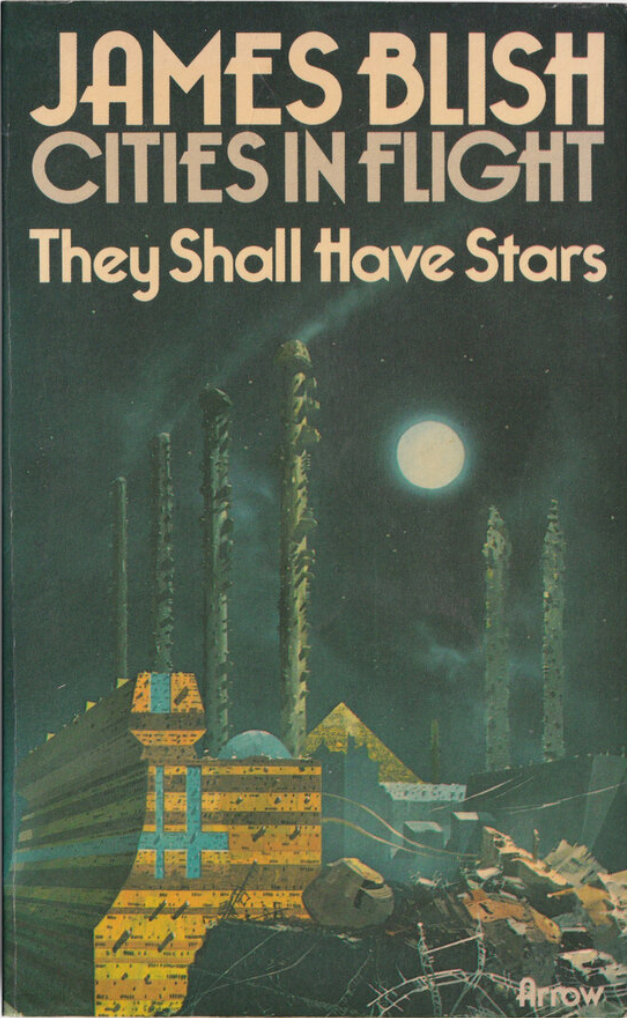
They Shall Have Stars (1956) opens in 2013. The Soviet Union has survived and flourished; the West, in response, has become increasingly authoritarian; scientific research, stifled by the new political environment, has stagnated. Senator Bliss Wagoner of Alaska secretly funds two research programmes that will change everything: the spindizzy drive and the anti-agathic drugs. The novel is a McCarthyite thriller clumsily interleaved with hard SF speculation, and bears little resemblance to the space opera that follows.
A Life for the Stars (1962) introduces Chris deFord, a teenager press-ganged into service when the city of Scranton takes flight. He eventually transfers to New York and rises through the ranks under the tutelage of John Amalfi, New York's mayor. It's the most accessible of the four – Blish wrote it as a juvenile – but reading it in sequence, knowing Chris's eventual fate, gives the whole thing a bleak irony.
Earthman, Come Home (1955) is the core of the sequence, assembled from the original Okie stories. The Okies were the itinerant, jobseeking poor created by the depression of the American 1930s – Blish is explicitly invoking Steinbeck's The Grapes of Wrath. He maps this to the cities in flight: their economy has collapsed, forcing them into space, and they travel from system to system looking for temporary work. The settled planets – the "Statists" – despise them, calling them Okies to mark them as vagrants, thieves, cheap labour. It is one of the most effective metaphors in the series: taking the highest technology imaginable and using it to tell a story about the lowest form of economic existence. The economics were substantially brainstormed by Campbell as Blish's editor; Knight subsequently noted that, well, surely they'd just trade. New York wanders the galaxy, taking contracts, dodging the cops (the "Interstellar Master Traders"), and navigating the politics of a declining civilisation. It's episodic and occasionally exciting, though Amalfi's invincibility becomes wearing. Ultimately Manhattan accidentally flees our own galaxy, ending in the foundation of a New Earth colony in the Greater Magellanic Cloud.
The Triumph of Time (1958) – published in the UK as A Clash of Cymbals – brings it all to an end. Literally. Amalfi, bored of life on New Earth, decides that this is really all about him. The universe is dying; a collision between matter and antimatter is inevitable. Most science fiction heroes would try to stop it or escape it. Amalfi decides to colonise it. In a final act of cosmic vanity, he races a peaceful alien species to the centre of destruction, determined to ensure that the next universe is stamped with the human pattern. He sacrifices his city – the thirty thousand silent ghosts who have served him for centuries – to ensure that the next cycle of history will repeat the same mistakes. He cannot abide a universe he does not influence. He must micromanage the Big Bang.
The original Masterworks edition included an essay on Blish's Spenglerian approach; the current version adds introductions by Adam Roberts and Stephen Baxter. Roberts suggests starting with Earthman, Come Home – the third book in internal chronology but the first published, closest to the original short stories. Baxter proposes A Life for the Stars as a launching point – the last written and most readable, though almost guaranteed to turn you against Amalfi when you discover Chris's fate. Tellingly, neither of them recommend the first book.
The Retrofitter
To understand Cities in Flight, you have to understand that it was built in reverse. And sideways. And then rebuilt again.
They Shall Have Stars is itself a 1956 fix-up of two separate, standalone stories published in 1952: "The Bridge" and "At Death's End". "The Bridge" – quite a decent novella about being trapped on Jupiter – produces the theoretical framework for the spindizzy (the "Blackett-Dirac equations", renamed the "Dillon-Wagoner equations" in the novel). "At Death's End" is the McCarthyite thriller. For the novel, the two stories are clumsily interleaved, and "The Bridge" is butchered in the process.
And then the entire sequence was, in turn, substantially rewritten and resequenced when Cities in Flight was first collected as an anthology in 1970. It's fix-ups all the way down.
The "fix-up" – Van Vogt's term for the haphazard stitching together of magazine serials – was in Blish's hands a deliberate act of system integration. He treated the 1970 omnibus like a refactoring project. Dates were retconned to align with Spenglerian cycles. Characters were inserted or deleted to maintain continuity.
The most brutal of these patches concerns Chris deFord. In A Life for the Stars, Blish created a new protagonist to serve as a relatable entry point for the reader. We watch Chris grow, learn the ropes, and eventually ascend to the position of City Manager, poised to become Amalfi's successor. But Chris didn't exist in the original Earthman stories, which featured Mark Hazleton as second-in-command. When the timelines merged in the 1970 omnibus, Chris deFord became a bug in the code.
A lesser writer might have rewritten the later books to include Chris. Blish simply executed him. A single line in the bridging text informs us that Chris was killed by the City Fathers for a "contract violation."
This isn't a plot twist. It's a patch note. Deprecated functionality: Chris_deFord. Status: Deleted.
The retrofitting didn't stop at characters. Blish kept bolting intellectual frameworks onto the chassis after the fact. Oswald Spengler's The Decline of the West gave his space hobos historical weight – the Okies as the final, frozen expression of Western technological prowess, wandering the galaxy in the "Winter" phase of civilisation.
The name "Wagoner" – the senator who funds the spindizzy research in They Shall Have Stars – was an early musical hint, perhaps unconscious. Richard D. Mullen, a Professor of English at Indiana State University and later co-founder of the peer-reviewed journal Science Fiction Studies, spotted it, built his hypothesis around it, and published his essay mapping the four books to Wagner's Ring Cycle in Riverside Quarterly in 1968. Blish, a musicologist and critic himself – writing under the pseudonym William Atheling, Jr. – adored this interpretation and canonised it by including the essay in the 1970 omnibus. A real academic had decoded his work; the essay was a shield against anyone who might dismiss the book as space opera. The UK title of The Triumph of Time – A Clash of Cymbals – underlined the orchestral conceit.
It was a classic act of retroactive intellectual elevation. Just as he used Spengler to give his Okies historical weight, he used Wagner to give his pulp adventures operatic grandeur. How much of either framework was really there from the start? The honest answer is probably: some, but less than Blish would have you believe. The "fix-up" isn't just a publishing format; it's Blish's entire creative method.
Even the relentless refactoring couldn't patch everything. Grand space histories must necessarily – cf. everything from Foundation to Dune – have fake historical encyclopaedia references as epigraphs, and Cities in Flight is littered with contextual look-back summaries from the mysterious historian entity Acreff-Monales. But the entire universe is destroyed at the end of book four. How does this particular encyclopaedia galactica survive to compile its entries? A final unresolved bug in the rewritten architecture.
The Potemkin Cities
That image, and the underlying idea, however far-fetched, is magnificent. But the cities themselves are strangely empty.
We're told New York is a metropolis, but the on-page evidence suggests a ghost town. The population counts are absurdly low – twenty or thirty thousand people occupying the shell of Manhattan. The streets are silent. There are no subcultures, no protests, no art scenes, no bustling markets. The "citizens" are invisible, invoked only as a voting bloc to ratify the Mayor's decisions.
Blish needed the visual grandeur of the skyscraper but had no interest in the sociology of the crowd. He was writing a naval procedural disguised as an urban drama. New York is the USS Enterprise writ large, with Amalfi as Captain and the City Fathers as ship's computer. The vast, empty avenues are merely bulkheads.
This emptiness aligns with the Spenglerian theme – perhaps more than Blish intended. The "Winter" phase of civilisation is characterised by the petrification of culture. The creative spark that fills a city with noise and chaos has been extinguished, replaced by the humming silence of efficient administration. The City Fathers – vast banks of vacuum tubes and memory drums that know everything but understand nothing – are the Winter made metal. Administration has triumphed over leadership. They can cite every law and calculate every course, but they cannot innovate. They are algorithmically risk-averse, logical, and utterly inhuman. They would ground the city to save energy; they would execute a citizen to satisfy a contract.
The Competent Monster
Amalfi is the archetype of John W. Campbell's "Competent Man" – the engineer-hero who solves problems through intellect and will. He's proto-Kirk: the charismatic captain who always knows best, whose hunches override the computer, whose crew exists to admire him. Blish went on to write the Star Trek novelisations; one wonders if he recognised what he'd created.
He sucks the oxygen out of every room. He tolerates no rivals. His affair with Dee Hazleton – his XO's partner – is treated with casual, proprietorial indifference. Women in the Okie universe are, at best, administrative assistants.
The Chris deFord execution is the most chilling evidence of what Amalfi's regime actually looks like. His protégé – the young man we've spent an entire novel watching grow up – is clinically murdered by the payroll software for a contract violation, and Amalfi barely registers the loss. This is the "Competent Man" with the mask off: a leader so focused on system integrity that the humans within the system become disposable components.
The Critic
The "future history" was a staple of the Golden Age, most famously codified by Isaac Asimov in the Foundation series. But where Asimov looked to Gibbon's Decline and Fall of the Roman Empire, Blish looked to Spengler. Asimov's model is narrative and political; it assumes that competent men can shorten the dark ages through rational intervention. It's optimistic – a liberal fantasy of technocratic benevolence.
Blish's model is biological and fatalistic. Spengler argued that cultures are living organisms with a fixed lifespan: birth, growth, maturity, and inevitable death. There is no Seldon Plan. The Winter phase is the end state, characterised by the dominance of money, the rise of Caesarism, and the petrification of the intellect. Cities in Flight is the chronicle of this Winter. The Okies have achieved immortality and mastered the stars, but they are culturally dead. They create nothing new. They scavenge the galaxy for knowledge because they have lost the capacity for original research.
Critics like Damon Knight forgave the emptiness because they respected the schematic. Knight demanded rigour and consistency above all else; he saw in Blish a fellow architect. If the city was empty, it was because the logic demanded it. To the technocrat critic, a boring but accurate system was preferable to a vibrant but illogical one.
I'm not sure that bargain holds up. These were the early days of SF criticism, and Blish collected free passes from every faction. The Campbell crowd gave him one for writing rigorous extrapolation. The New Worlds crowd gave him another for being Atheling, the critic who demolished mainstream SF. And Knight, who might otherwise have held him to account, was hardly going to turn on the only other person doing serious criticism at all. Nobody wanted to examine the work too closely because Blish was too useful as an ally. The result looks less like pure critical judgement than a consensus shaped by mutual usefulness.
The Covers
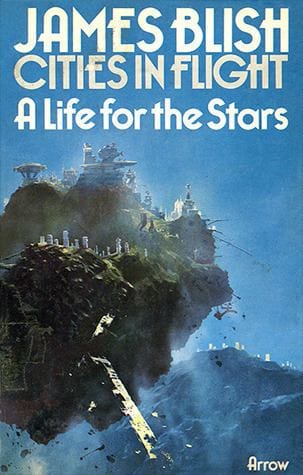
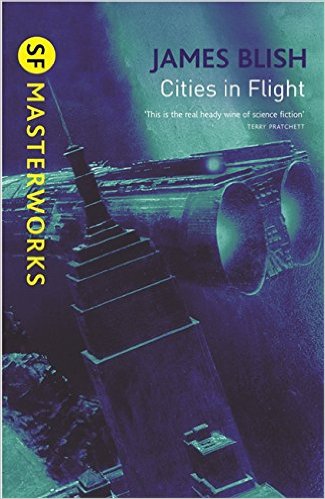
The SF Masterworks edition uses part of a far larger painting by John Harris. Harris paints with a hazy, impressionistic style: vague vertical shapes that suggest skyscrapers, no windows, no doors, light and shadow making the structure look continent-sized. The full painting shows a distant blue city; but Gollancz crops to the engine, and the yellow-and-white spine edition zooms in further still, which rather misses the point. What works about the Harris image is the mood – cold, distant, monumental. It feels less like a city than a tombstone for humanity, which is exactly what the city is.
The Golden Age
The Golden Age of Science Fiction is when you're twelve.[2]
I came to Cities in Flight about ten years ago, long past any golden age, with no childhood attachment to protect it. Roberts and Baxter wrote introductions I genuinely cannot understand. I suspect they read these books young and gave them the free pass that early love provides. I didn't, and I can't.
I have affection for classic SF – real affection, born of that wall of Panther paperbacks in a caravan park shop in Wales. But I'm glad this wasn't my entry point. When I read Cities in Flight now, I recoil at pretty much all of it: the empty cities, the disposable women, the protagonist who mistakes sociopathy for competence, the intellectual frameworks bolted on after the fact to disguise the poverty of the human content.
There was probably a vivacity in the original stories, quickly dated though it was – you had to appreciate the Depression references, for one thing – and "The Bridge", by itself and in its original form, was excellent early hard science fiction. But the rewrites, the resequencing, the jarring tonal shifts: none of it works, and it broke whatever was there in the first place. Then came all those competing layers of retrofitted meaning – Spengler, Wagner – piled onto a structure that couldn't bear the weight. The result is a mess. Those introductions by Roberts and Baxter – are they really praising the original ingredients, the actual Golden Age stories? Or are they praising this Frankenstein creation of 1970? I'm not sure, but I think and hope it's the former.
Postscript
When I first started trying to write about Cities in Flight, a few years ago, I bought the definitive Blish biography: Imprisoned in a Tesseract by David Ketterer. I found my copy on AbeBooks. What I didn't know when I bought it was that the interior includes a sticker reading "Ex Libris John Brunner", with Brunner's signature alongside it. Blish and Brunner were critical allies in the UK scene; Blish championed Stand on Zanzibar and wrote an essay defending Brunner against charges of mere technician-hood. Throughout the biography, there are various "!!" exclamations written in the margins at odd intervals. I ought, at some point, to catalogue them.
Member discussion