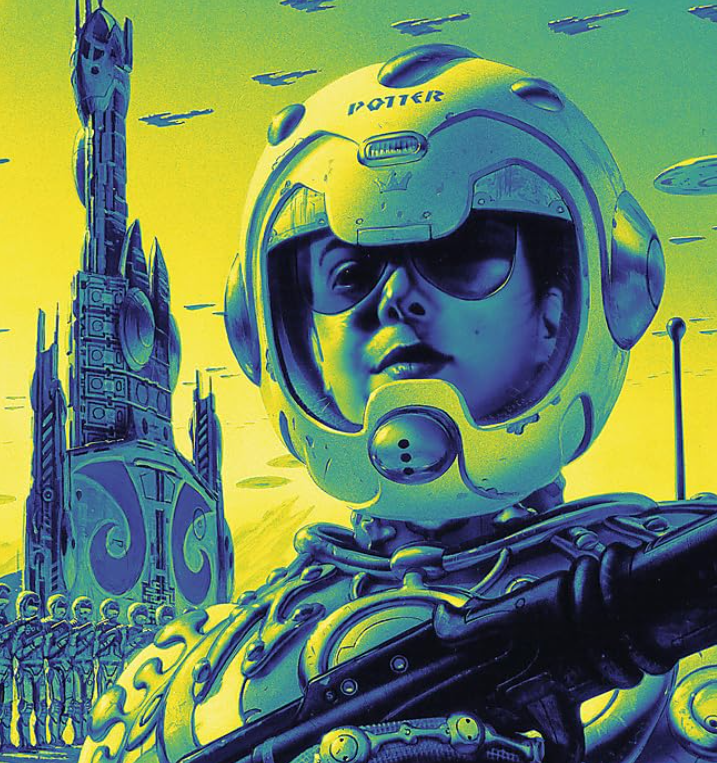
War is Hell, Sex is Complicated
SF Masterworks #1: The Forever War, by Joe Haldeman
Spoiler Warning: This review gives away the plot of the book. Completely.
'Tonight we're going to show you eight silent ways to kill a man.' The guy who said that was a sergeant who didn't look five years older than me. So if he'd ever killed a man in combat, silently or otherwise, he'd done it as an infant.
— The Forever War, Opening lines of Chapter 1.
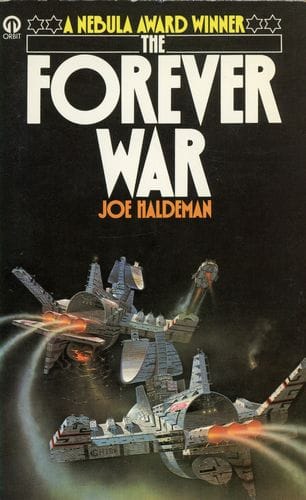
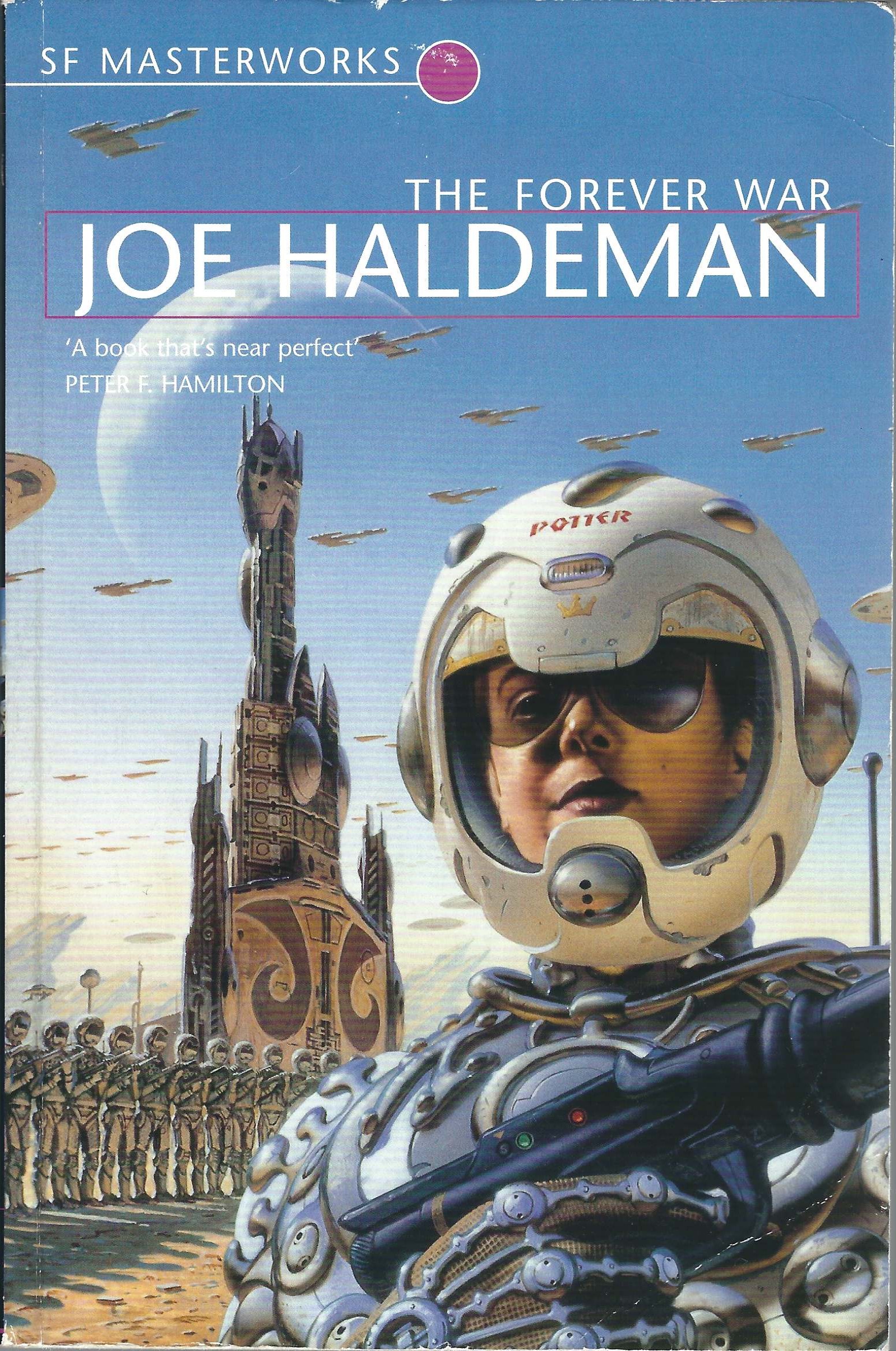
I calculated I had enough money - if I missed lunch - for three books. Alongside The Forever War, I selected Philip K. Dick's Clans of the Alphane Moon and Ursula Le Guin's The Left Hand of Darkness. I had never heard of any of these authors, but I had, from picking up books at the library, heard of the Nebula and Hugo awards. The loud proclamations on the covers of both The Forever War and The Left Hand of Darkness were selling points enough for me (at that point, the Orbit cover - as reproduced here - carried only the 1975 Nebula victory; the book went on to sweep up the Hugo and Locus awards as well, in 1976). For the Dick novel, I just liked Peter Jones' cover illustration.
I got lucky. The Forever War and The Left Hand of Darkness came very quickly to be regarded as masterpieces. Clans, though I have a considerable affection for it, is regarded as a minor contribution to Dick's oeuvre. Lawrence Sutin, in his excellent Divine Invasions, gives it a 7 out of 10: "an uneven novel, but there's nothing else like it."
For me, at the time, it was The Forever War that made the deepest impact, in particular the opening section, with its depiction of the deadly training regimes of the soon-to-be Space Marines. Even at the time, the Vietnam analog was obvious. I was 12 years old when Saigon fell; though the UK had taken no part in the war, I had traced the progress towards collapse in the daily BBC radio bulletins on our bus ride to school. I remembered the ending of the novel as romantic, happy even. But when I came, much later, to reread it, I found I'd forgotten much of what happens between the breakneck first quarter and the final paragraph.
"Being in combat changes your life completely, usually for the worse. It's not specific things that happen in combat, it's a kind of gestalt - living with horror for day after day after day, and finally you've sort of moved away from the human condition. And you never quite get back, no matter how many years go by. I've seen this in old, old men who were in World War I. I look in their eyes and I see myself. They can never be completely kind. They can never be completely humane."
— Joe Haldeman, interviewed in Locus magazine, 1997
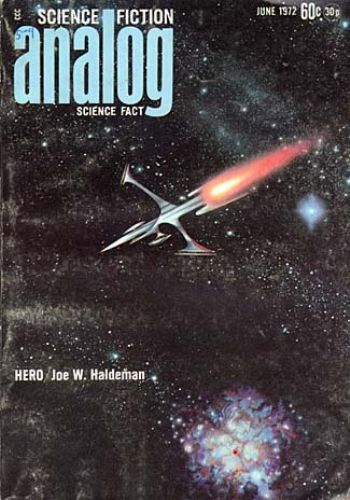
The Forever War was first published as a series of stories in Analog magazine, starting with "Hero" in June 1972. Editor Ben Bova rejected one segment, "You Can Never Go Back", on the grounds of its being "too downbeat"; the original novel replaced this with a more streamlined bridging sequence. By 1976, the book had won both the Hugo and the Nebula.
There are therefore four versions of the novel: the original Analog stories; the 1975 novelisation with the streamlined middle section (the award-winner); a 1991 edition restoring "You Can Never Go Back"; and the 1997 revision cleaning up inconsistencies from that restoration. It's this last version - the author's preferred - that you'll find in current editions, including the SF Masterworks. So the book you buy today is actually not the edition that won those awards. The version that swept the Hugo and Nebula had been editorially softened to make it more palatable - and ironically, by restoring the bleakness, Haldeman made it a more honest reflection of the Vietnam veteran's experience.
Whichever edition, The Forever War is still considered a masterpiece of science fiction. It was - and remains - a skilfully constructed SF-based liberal critique of the Vietnam War, published shortly after the event, by an author who had actually participated in the war. It was an expression of the alienation felt by returning soldiers, to an American society which had undergone significant transformations in their absence. In both respects, it was early; even outside the SF genre, substantial and authentic works on Vietnam, by veterans or journalists who had been present, were rare. Tim O'Brien's If I Die in a Combat Zone appeared in 1973, Robert Stone's Dog Soldiers in 1974. Michael Herr's Dispatches wasn't published till 1977. Hollywood didn't get round to dealing with the issue until The Deer Hunter in 1978; Platoon, Full Metal Jacket and Jacob's Ladder had to wait till the 80s.
The book opens in 1997. The United Nations of Earth are a year into an interstellar war with the mysterious Taurans. Earth has conscripted an elite corps of soldiers - all in top physical condition and with IQs over 150 - to guard the "portal planets" at the choke points of interstellar travel. William Mandella is swept up in the draft. Much of the opening section is devoted to training in extreme environments with live weapons - so dangerous that several recruits are killed before they see combat. These scenes stick in the memory; forty years after first reading the novel, it's this section that came most immediately to mind when I picked it up again.
Long distance space travel takes place through "collapsars", instant transportation gateways between star systems. But travel to and from the collapsars necessarily takes place at very high speeds, close to the speed of light. Time spent on campaign accumulates a relativistic debt; the first campaign lasts two years in "real time", but almost thirty years pass on Earth.
By this time Mandella has fallen in love with one of his comrades, Marygay Potter. The two return to an Earth no longer recognisable. In the 1975 version, the world is strange but functional, and they re-enlist largely out of future shock. In the restored 1997 version, Earth is nightmarish: the economy is in ruins, medical care is rationed to the point of death sentences for the elderly, gangs roam freely, attacking innocent citizens at will. Mandella and Marygay's re-enlistment represents a desperate flight back to the only safety they know.
A thousand years into the future, mankind is now made up exclusively of clones, connected in a hive mind like the Taurans. Mandella is sent to a reserve for the original, pre-collective, heterosexual humans. There he's reunited with Marygay, who has been cruising in space, burning objective time, to wait for him. A news item announces the birth of a "fine baby boy".
This was the happy ending I remembered at 13. Haldeman has been at pains to emphasise this isn't the right reading. At the novel's conclusion, Mandella and Marygay are living on a reservation - in the 1975 version called "Finger Station", renamed "Middle Finger" in the 1997 edition, Haldeman's final dryly humorous salute to the military-industrial complex and perhaps his original editors. His protagonists are now evolutionary dead ends, allowed to exist as a courtesy, on a world set aside for a species that is effectively extinct. The baby is a victory for the individuals, rendered meaningless by the total defeat of their kind.
The comparison to Heinlein's Starship Troopers (which came almost immediately on publication) is unavoidable, though Haldeman has claimed he wrote much of the novel without it in mind. The structural parallels are obvious: elite soldiers, deadly training, powered armour, interstellar war against alien bugs. But the books are ideological opposites.
Haldeman, on the other hand, did see combat. The UNEF in The Forever War is not a meritocracy but a killing machine that exists - as we eventually learn - largely to perpetuate itself. The Taurans are barely present; we learn almost nothing about them until the war's end, when it transpires the whole thing was a manufactured misunderstanding. The sacrifices - and the societal transformations they drove - weren't worthwhile. They were pointless, at best accidental and at worst evil.
My memory of the book, from that first reading at 13, was of military science fiction - dominated by the Full Metal Jacket-style training sequences. Rereading it now, I'm struck by how much it's also a time travel story.
The relativistic effects mean Mandella ages years while Earth ages centuries. He returns, repeatedly, to a world increasingly unrecognisable. The society he left - heterosexual, ethnically diverse, English-speaking - gives way first to mandatory homosexuality and population control, then to a uniform ethnicity, then to clone consciousness and finally to a collectivist hive mind.
Wells' Time Traveller visits 802,701 and finds humanity bifurcated into the ethereal Eloi and brutal Morlocks. He's an observer, a tourist with a machine. Mandella, without such luxury of choice, doesn't arrive as a sophisticated Victorian among degenerates. He arrives as the primitive among the evolved, marked out by his heterosexuality, his individuality and his experience of violence. He's the Morlock, lost in a world of Eloi (an interesting echo occurs in the second SF Masterworks novel, Matheson's I am Legend, where it could be argued the protagonist executes a very similar arc).
Then there's the issue of the mandatory homosexuality. Haldeman intended this as an estrangement device, a marker of how far the future has drifted from Mandella's baseline, another signal of his descent into alienation. It's framed as a practical response to overpopulation - Earth now no longer needs reproduction, so why should it maintain sexual relationships? The heterosexual male soldier is rendered obsolete, and with him an important aspect of Mandella's identity. Here's what Haldeman said in a 2004 interview:
I suppose it was a little bit daring at [the] time; it was very daring in science fiction. So I had gay characters in The Forever War (1975). That was for a specific purpose. It wasn't about homosexuality. It was about being isolated. I had my character being the only straight in a universe of gays just to show what's "queer" is being different from everybody; there's not a universal set of things that makes one person queer and one person not queer.
— Joe Haldeman, interviewed in Strange Horizons, 2004
Whatever Haldeman's intent, there's an odd tension in the novel between his use of homosexuality and his attitude to gender politics. The earlier sections treat female combatants as Mandella's equals, in training and on the front line. This makes the illiberal later framing even more jarring. Haldeman wasn't acting out of malice, but the mechanisms he chose haven't aged well. Science fiction analogies serve as powerful tools to present contemporary anxieties. But they risk preserving these anxieties in amber, long after they've become irrelevant and exposing them to later readers in ways the author never originally anticipated.
This doesn't invalidate The Forever War. But it does date it, in ways that the hand-waving physics and the powered armour do not.
Editions and Covers
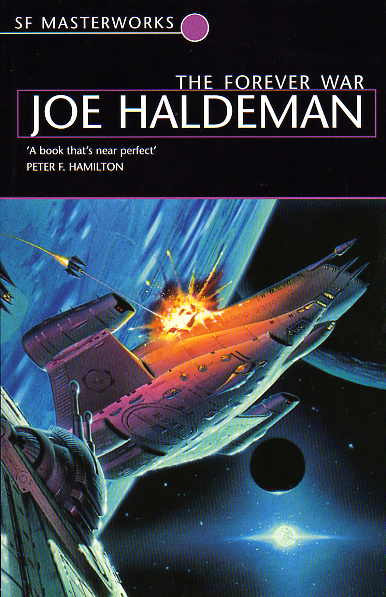
When Millennium initiated their SF Masterworks series in 1999, they selected The Forever War as the first volume - the 1997 author's preferred edition. Gollancz republished it in their 2010 relaunch with an introduction by Adam Roberts and an afterword by Peter Hamilton.
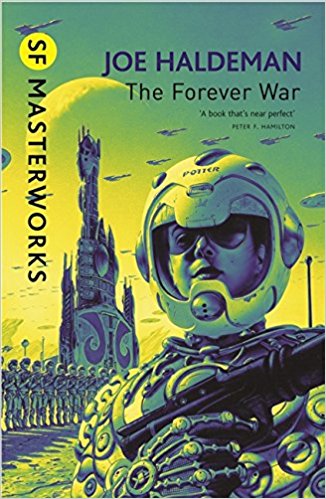
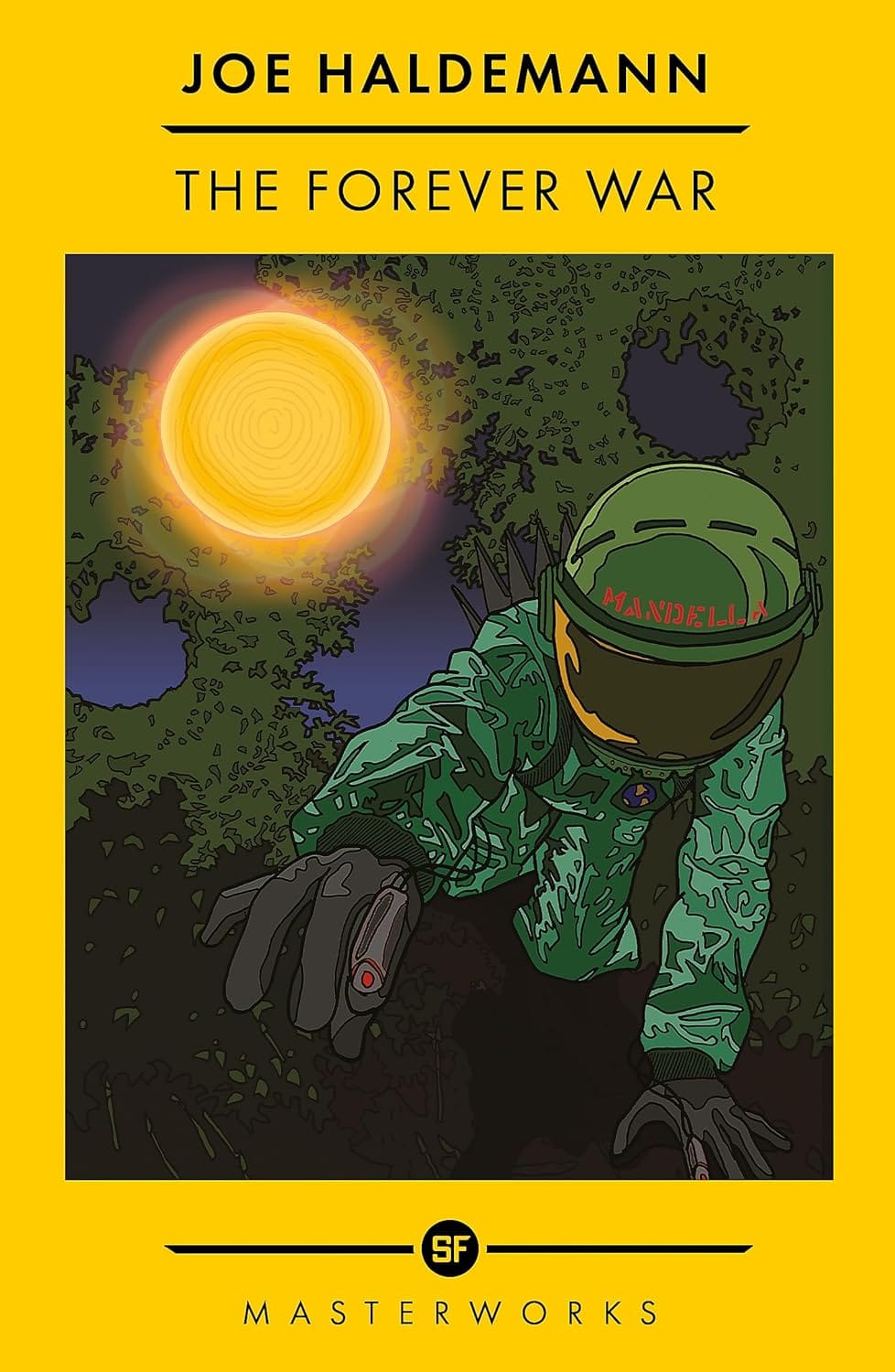
The first three Masterworks covers are by the late, brilliant Chris Moore. A recent, limited "Best of Masterworks" edition breaks the pattern with a different artist (Autun Purser - and I like the illustrations, although the very idea of this limited series, when the main series is still there, annoys me), and there's a difficult-to-find hardcover from an earlier limited series featuring a more expansive version of Moore's original first edition artwork. The yellow-and-white-spined edition was one of the first in the relaunched series, establishing the carcinogenic glow that Gollancz apparently believes sells books. It does not.
Member discussion